

AI’s Butterfly Effect: How Rapid Adoption Is Unleashing Unintended Consequences and a Wild Ride Through the Economy, Labor Market, and Creative World
Chaos – there’s a theory for that.
Appropriately, it’s called Chaos Theory.
You’ve probably heard the phrase, “Expect the unexpected,” …
…that’s chaos theory in a nutshell.
It’s the science world trying to make sense of things that don’t make sense.
A discussion that’s right up my alley.
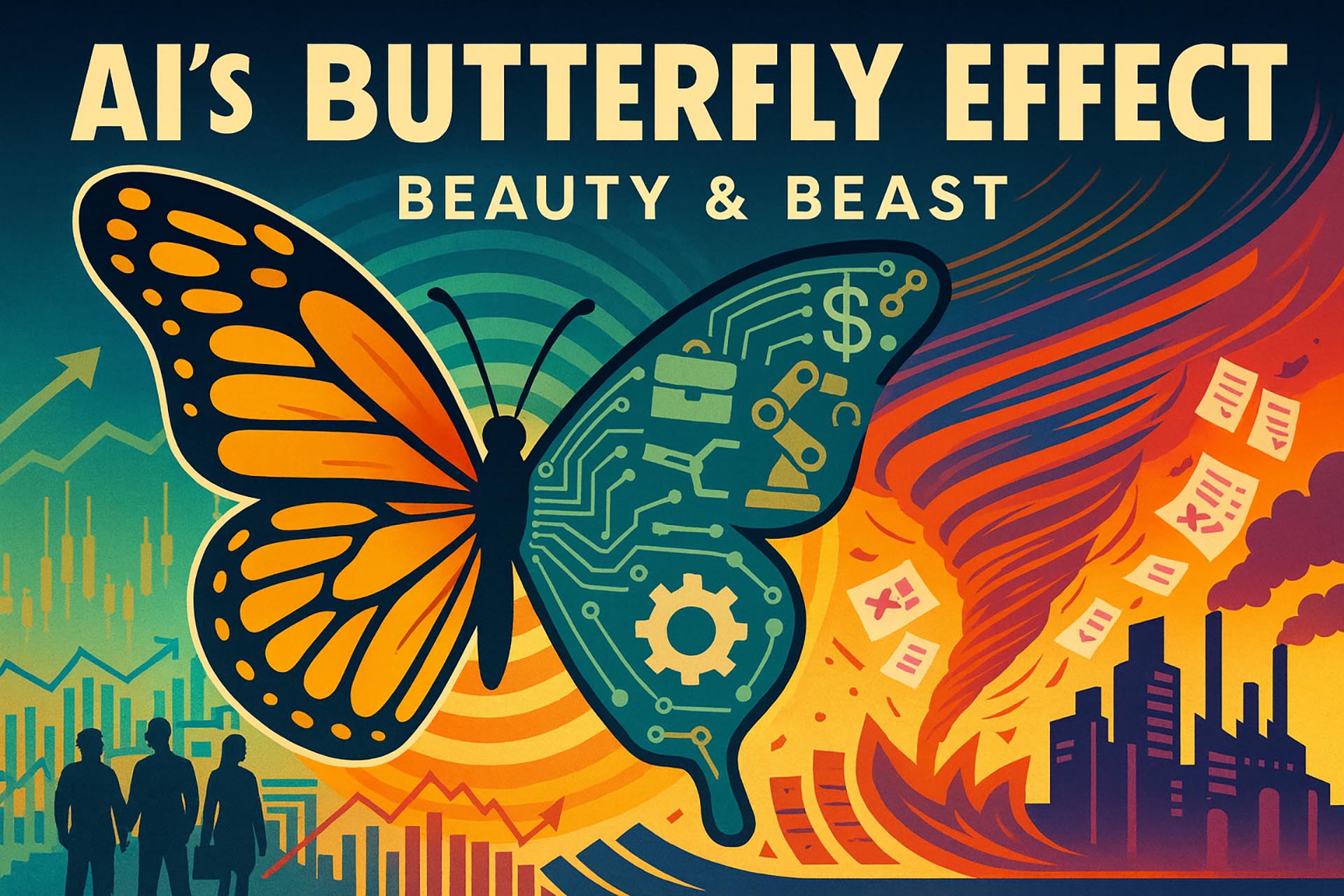
The “butterfly effect”, coined by meteorologist Edward Lorenz, suggest that minor events, like a butterfly flapping its wings, could theoretically trigger a chain reaction that results in a much larger event later – like causing a tornado on a distant land.
In 1972, Lorenz posed a thought-provoking question:
“Predictability: Does the Flap of a Butterfly’s Wings in Brazil Set Off a Tornado in Texas?”
To bring this concept current, I’ll ask the following question for my fine friends of the muse to ponder:
Is the rapid and widespread adoption of artificial intelligence (AI) creating a “butterfly effect” across the economy – with seemingly minor AI developments silently triggering massive unintended ripple effects in business models, industries and labor markets?
My answer: “hell yes.”
Consider:
The public release of OpenAI’s ChatGPT – a single event – sparked a global chain reaction: millions of users adopted AI overnight, competitors rushed out rival models, venture capital flooded into AI startups, and companies scrambled to redesign workflows around generative AI.
In fact, these second/third-order effects were much larger than predicted…all from just one new “technology tool.”
When examined more closely, the rapid rise of AI is creating non-linear, outsized outcomes embedded in a paradox of unintended consequences.
The business world (and world) as we know it – will never be the same.
Let’s explore these ripple effects that are emerging from the AI revolution…
…buckle up, this is going to be a wild ride.
AI’s Hurricane Force Winds of Change
Today, minor AI innovations generate exponential ripples in the economic environment.
A hallmark of the current AI tidal wave is the unprecedented speed and scale of adoption, which itself magnifies and intensifies the small effects.
From a historical perspective, transformative technologies of the past took years or decades to become significant…
…electricity took over 30 years to spread from cities to farms…
…the internet needed about 5 years to reach mainstream adoption…
…but AI has exploded in mere months.
For example, in the U.S., the share of employees using AI at work doubled from 20% in 2023 to 40% in 2025. Likewise, about 78% of organizations reported using AI in 2024, up from just 55% a year before.
Just look at the rise of OpenAI’s ChatGPT since its release in late 2022. Within a year, ChatGPT and similar AI tools were integrated into office software, search engines, customer service workflows, sales and marketing – and the list goes on.
This single “butterfly” event led to a surge in AI investment (over $33 billion poured into generative AI startups in 2023 alone.
Fast forward just two short years and global investment in AI is projected to be $1.5 trillion in 2025 with major tech companies alone planning on spending between $300-$400 billion on AI infrastructure this year.
In less than 3 years, the global economy is an AI arms race that knows no limits!
The stage is set for non-linear, exponential, nuclear change.
Are you ready?
The Productivity Paradox
You know I love a good irony or two, so let’s dive into a big one.
We’ve got a mighty big and shiny productivity paradox in the works with AI: despite all the lofty promises, AI’s boom has not yet delivered the sweeping efficiency gains many expected (and in some cases, it’s introducing new inefficiencies).
Remember the famous Robert Solow’s Paradox from the computer boom in the 1980s… that said the rapid growth of the computer age was not reflected in productivity statistics.
In Solow’s words: “We see computers everywhere except in the productivity statistics.”
Here are some cold, harsh facts for you to mull: According to a study published by the National Bureau of Economic Research in 2025, AI assistance in real workplace settings yielded only about a 3%-time savings on average.
Another large-scale analysis of 25,000 workers in AI-exposed jobs (like software development) showed “AI chatbots have no significant impact on earnings or recorded hours so far.”
So, even though AI is everywhere, the productivity needle has hardly moved.
Why?
History provides clues. In the 1960s – 1980s, businesses invested heavily in computers expecting immediate efficiency gains, but the promised gains didn’t materialize for decades.
Managers spent a ton of dough on IT systems and hired armies of specialists to maintain them – resulting in a bloated and inefficient workforce.
Economist Paul David’s research on past innovations noted that new technological advances create a messy transitional period of “intense conflict, regulatory battles and struggles for market share,” where the old and new ways coexist, dragging down efficiency.
In fact, the dot-com paradox in the late 1990s tells another cautionary tale – where efficiency/productivity declined again “despite (or because of) the birth of the internet.”
Don’t be fooled, AI’s productivity day is coming fast, very fast.
But just like the dot-com bubble, this too is a bubble – perhaps the biggest in history.
One of the founders of OpenAI, Sam Altman, said it himself.
But don’t lose sight of the paradox here – because it has massive consequences.
Just think about your life today and how much it has changed in the last 5-10 years…
…look at all the connected devices that devour every moment of your time today.
Technology has trapped us in its web.
AI is the spider that’s going to finish the job.
For me the biggest paradox of them all is the “yet to feel” tornado about to hit the labor market.
While Wall Street and the Mag 7 are giddy about the coming AI productivity revolution, nobody is talking about the ripple effect…the loss of labor at scale.
It’s no secret, the cost of human capital is among the highest in any business/industry…
…this is where AI’s productivity “gains” become realized…
…where the old “fixed costs” become “fixed efficiencies/savings.”
The cold, hard facts: A small sample of major job losses in 2025
- Amazon: 14,000 job cuts – citing “a shift towards AI”
- UPS: Reduced workforce by 48,000 from last year
- Microsoft: 15,000 job cuts – citing “heavily investing in AI”
- Chegg: Laid off 45% of its workforce – due to “the impact of AI”
- Nestle: 16,000 job cuts – citing “a shift towards automating our processes”
- Salesforce: 4,000 job cuts – as it implements “AI in the workplace”
- Target: 1,800 job cuts – citing “restructuring”
I’m not trying to go all doom and gloom on ya here – I’m reading the data.
Open your eyes and ears, folks the world is a changing.
Don’t be a spectator – it’s time to actively participate.
To be sure, AI’s impact on productivity is in its infancy…
…the ripple effects from its “butterfly effect” will be non-linear and geometric in scale…
…it’s the mightiest of double-edged swords that humanity has faced…
…and offers a good reason to think about and study its implications.
Now that you have been properly slapped in the face and are awake, let’s move on
This Beautiful Butterfly Has Lost Its Wings
Sadly, and dear to my heart, the creative world is being turned upside down too.
AI’s foray into the creative domains (art, design, photography, videography, cinema, music, etc.) – comes with a promise to amplify human creativity.
All true.
But this creative paradox once again reveals itself – that generative AI is doing the opposite of “creating” – resulting in homogenized creative “output” everywhere you look.
Consider – the very tool meant to unleash limitless creativity to the masses is instead ushering in a new world of “creative uniformity.”
What an utter shame.
Think of the implications here – a creative world where you have “average and conformity” at scale.
You can already see this dynamic in full force in the sales and marketing world…
…generic AI-generated copywriting all over the place…
…generic AI-generated content all over the place…
…AI created ads, slogans, logos, marketing content…you name it!
Beware – because the coming “sea of sameness” is accelerating and will create a gravitational pull towards the mean – the safest, most common, non-creative.
We’re creating a creative world that snuffs out the rule breakers and outliers…
…because average demands to be average.
We’re at the dawn of a “creative convergence.”
A world where an AI-generated musical artist, Xania Monet, reportedly signed a $3 million record deal. Another AI-generated actress, Tilly Norwood, is drawing interest from Hollywood talent agencies.
You see where this is going?
To my creative friends of the muse – stay unruly in your craft and refuse to be average!
Chaos Loves Contradiction
Are you starting to see a pattern here?
The “butterfly effect” is not just a metaphor here – it’s a real description of how AI’s integration into our world behaves like a complex adaptive system…
…because chaos theory demands it.
Chaos theory reminds us that in complex environments, prediction is hard.
Our new normal is to expect unintended consequences as a rule, not an exception.
This new world we live in today will not behave predictably, so we need to act accordingly.
That’s why contrarian thinking is coming of age…again.
Dare I say that you should be deliberate in challenging every prevailing assumption about AI’s impact.
In complex systems and environments, contrarian insight is critical because the majority always aligns with linear thinking…
…and AI ripple effects are non-linear.
The “law of unintended consequences” – a staple in economics and sociology – is the butterfly effect that AI represents.
It’s time to brace the chaos – because it can’t be controlled or predicted.
The safest place left for us may be in the “eye of the hurricane,” make that your mental center and foundation.
Focus on building adaptive and resilient systems that you can control.
We can stop debating whether AI’s impact will be net negative or net positive – all you need to know is that it will be non-linear and multi-faceted.
From a historical perspective, this ain’t our first rodeo…
…but the horses are different.
But we’ve navigated similar turbulent transitions before.
It’s astounding to think of the technological progress we’ve made over the last 100 years.
What used to take decades takes months…soon it will be weeks, then days.
The butterfly effect of AI is already in motion…
…it’s a beauty and a beast.
Rather than fight it, we must learn to ride and harness the wind it generates and correct our course as needed.
The butterfly has taken flight – now it’s up to us to navigate the chaos and storm.
