
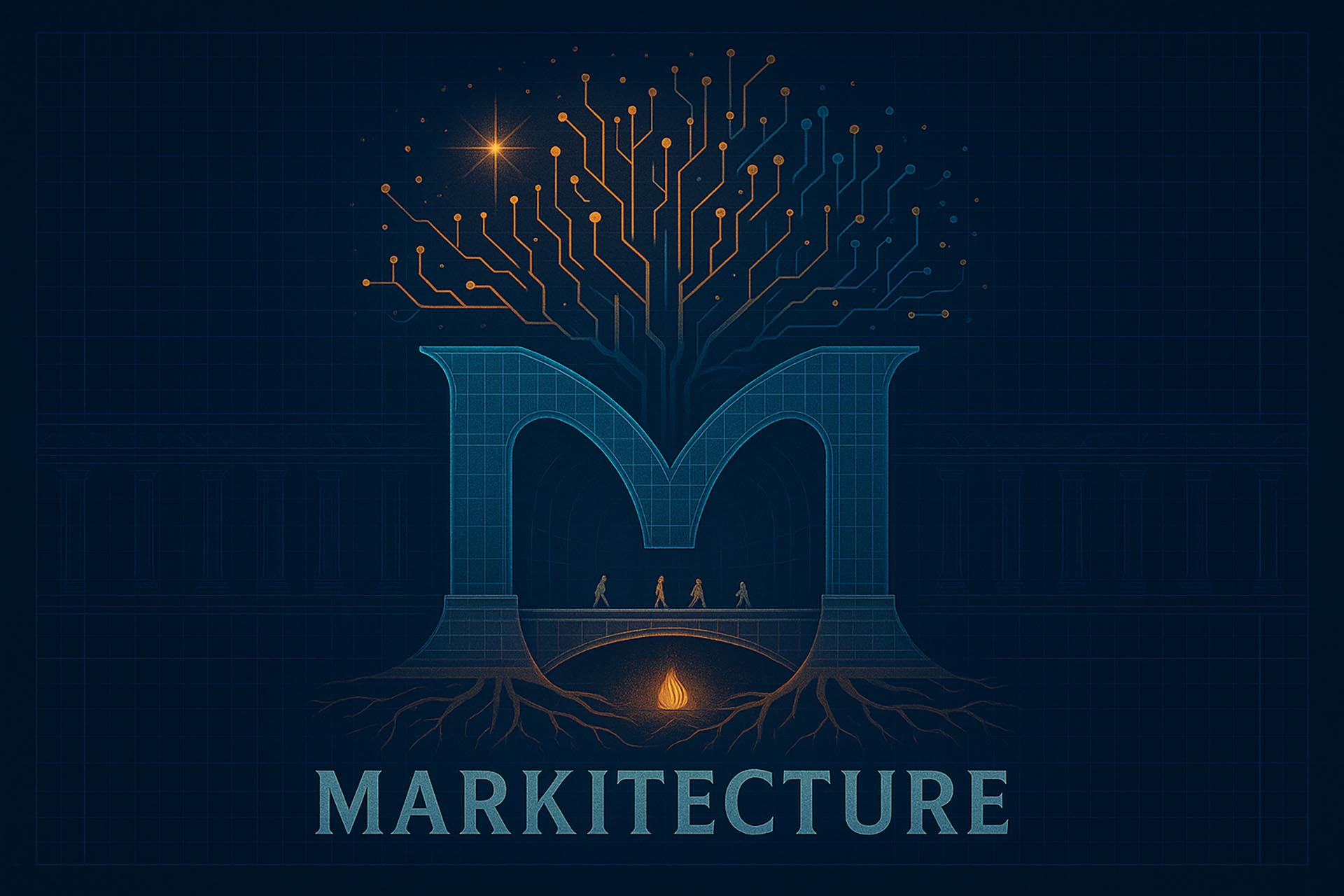

Markecture: A New Philosophy for Building Magnetic Brands
Yes, that’s a word.
I just made it up.
What is it?…
…it’s a synthesis of various thoughts, ideas, and reflections I’ve had over the past decade plus on the topic of marketing – business building – growth – strategy, etc….
…while actively participating in the eternal struggle to capture consumer attention and engagement in today’s digitally addicted world.
It’s my answer to the question:
What the hell do we do now?…
…now that technological advancement has hit hyper-sonic levels…
…now that the “Artificial Intelligence horse has left the barn” …
…now that business as we once knew it no longer exists.
We’re at the tipping point – it’s time to flip the script and turn everything upside down so it makes sense again.
It’s why IMHO, it’s time for us to reimagine, redesign, and reengineer the marketing and business world as we know it today…
…because what the biz world needs now is Markecture.
Markecture is what happens when marketing and architecture collide to create a visceral, magnetic, and remarkable consumer experience – one that is built to last.
Imagine, if you can, exciting the electromagnetic fields of each particle (marketing and architecture) then accelerating them to the speed of light and have them crash together…
…this is how you can fundamentally rewrite the existing forces that govern business growth today…you create Markecture.
It’s how great brands are built…
… they’re talked about among friends…
…they leave a lasting impression…
…their product/services are sought after (and don’t rely on just “being found.”)
This is the magnetic energy force that creates Markecture.
Buckle your seatbelts, my friends of the MUSE – I’m gonna stitch together some different thoughts for you to ponder in my quest to enlighten your intellect and inspire your soul.
May you find your own version of Markecture.
BREAKING: The Business World Has Changed
Have you noticed?
The digital revolution is history, old news folks, as in – way old news!
Today – what’s new is what’s new for about 90 days tops – then it’s old news.
A.I. has accelerated EVERYTHING, and it won’t stop until it eats us alive!
Consider all of the “social data” the tech companies have collected and analyzed over the past two decades. Perfect preparation for what comes next:
- LinkedIn started in 2003
- Facebook started in 2004
- Twitter (X) started in 2006
- Instagram started in 2010
- TikTok started in 2016
- Open A.I. Chat GPT’s initial release date was November 30, 2022…
…and just look what’s happened in 3 short years!
Now here’s the mic drop factoid that should blow your fertile mind:
Worldwide spending on AI is forecast to total nearly $1.5 trillion in 2025, according to Gartner, Inc.
Never mind we’ve got self-driving cars, self-flying personal cars, electric air taxis, personal electric aerial vehicles on the horizon – and that’s just the beginning.
I’ve said it before, but now I mean it – it’s the Wild West all over again.
To say these are interesting times diminishes the point – it’s a new paradigm.
The business world has surely learned the new way to build billion-dollar empires…
…with massive leverage and network effects.
Case in point:
The world’s largest taxi company, UBER, owns no cars. The world’s largest media company, Facebook, creates no content. The largest real estate brand, Zillow, sells no real estate (err, now it does, more on that at a later date.)
Today’s “market makers” are the markets themselves.
It’s all about network effects on steroids today – that’s what created the “MAG 7.” If you don’t know what the “MAG 7” is, please look it up and consider the implications…
…because our entire World is shrinking before our very eyes…
…the paradox of choice will soon be a thing of the past…
…a new Roman A.I. Empire is being built…
…are you ready?
Content Used to Be King, but Not Anymore
Content used to be scarce, supplied in most part by the largest “analog” media companies of the day, and distributed on a finite number of mediums. In those days, marketing was all about the macro – get your brand and offering in front of as many eyeballs as you can, the more the better. Focus on CPM.
In fact, marketing was much simpler and straightforward then. “Spray and pray,” marketing was the norm and didn’t require a high level of strategic thinking, but you needed big dollars to play the game and win.
The problem, back then as it is today, is relevance. If you were trying to target stamp collectors, how relevant was your big-dollar advertisement in TIME magazine or the New York Times newspaper? Of the millions in circulation that you paid for, how many readers were stamp collectors? The challenge was the same with the other media channels – TV, radio, billboards, and direct mail. You might have known how old they were, if they were male or female, and if they had a college education – but interested in stamps?
Today, content is abundant, and you have an infinite number of distribution channels to deploy. Content creation at scale is a race to the bottom of the sea, and those fish don’t pay much attention.
The “good news,” now you can laser target any niche audience you want and spam them anyplace, anywhere, and anytime. And marketers have taken the bait – ruining consumer trust in the process.
The marketing buzzard’s mantra – “if I can, I will.”
A.I. will only further weaponize marketing until the entire system implodes – which is why we must START OVER and THINK this thing called the “future” through a little bit more.
It’s time to get old school cause it’s the new school.
Micro is the New Macro
According to eMarketer, global ad spending is predicted to reach $1 Trillion in 2025, with digital ads making up about 75% of that total.
Unfortunately, most of those ad dollars will go to waste – never reaching their intended and most relevant audience and thus offering no return on investment.
For a more in-depth deep dive, here I highly recommend you read my article Dead Internet Theory: Part II – it will surely raise your eyebrows!
Footnote here: I highly recommend the Seth Godin seminal book “Tribes: We Need You to Lead Us” – which talks about how the Internet has ended mass marketing and how founded on shared ideas and values, tribes give ordinary people the power to lead and make big change.
But let’s get back to the task at hand – what the hell can marketers do today to combat the changes in the market…go back to basics.
The BASIC challenge that every marketer faces is how to best engage and delight consumers, so they eventually become customers and brand enthusiasts.
But how?
You need to move them from point A (current state) to point B (their desired state.) To do this you need to build a bridge that the consumer can safely cross to reach their destination.
To ensure this happens, you should use Markecture to engineer the bridge because the result will be transformational.
Face it – you can’t change what you can’t change. Yes, there’s too much content out there, too much noise, too much attention friction, too much spam, too much marketing, too much of everything!
So, what?
Everyone is in the same boat. Get over it. Go back basics – tell story that people give a $h!t about.
Wait, did I just say “story?” Well, that’s pretty old school, ain’t it?
Yup, and it works…and always has worked.
It’s Time to Get Back to Basics
Consumers are too smart, sophisticated, and will tune out your marketing noise pollution.
Instead, be authentic and invite consumers into your unique story. Dig deep, be vulnerable, be honest, and don’t pretend to be perfect.
In today’s crowded and commoditized marketing environment, the value your brand brings to the market needs to be more than a bullet point list – consumers are real people and need to make an emotional connection to your brand story.
What’s your story?
Best-selling author and business leader Tom Peters said it best, “He who has the best story wins.” Case in point, I bet you already know the creation stories for Apple, Microsoft, and Facebook. Your brand story allows consumers to better understand who you are, why you do what you do, and relate to your ups and downs along the way. An honest and authentic story can create an immediate connection with consumers. If your prospects know” how you became you,” they’ll be more likely to trust you – and therefore do business with you.
Differentiation starts with being authentic
As a starting point, ask yourself the following questions.
- Why are we doing this? What is the purpose? Why do we exist?
- What problems are we trying to solve?
- What do we stand for?
- Why should people care?
- Would the market miss us if we were gone?
Too many brands think their story is about industry status, rank, and authority – but this is just personal gratification, but the truth is that no one really cares.
Every Brand Has a Story – it’s your “StoryBrand”
Best-selling author Donald Miller’s seminal book “Building a StoryBrand” provides an excellent framework to help you clarify your message so consumers will actually listen.
Researching the way stories have been told in movies and throughout history, the StoryBrand concept is about inviting customers into a story, and that companies need to understand that their brand is not the “hero in the story,” the customer is. The brand’s role is to successfully guide the customer through their challenges and be the “Yoda to Luke Skywalker.”
Every memorable story and blockbuster movie is built on a simple framework.
Hero has a problem. Meets a guide who gives them a plan.
Calls them to action. Failure would be devastating but the guide navigates the hero to success.
So, invite your customer into a story and give them a vision of a better life, help them overcome challenges, act as their guide in the journey, and take them to a climactic scene so their story ends happily.
Campfire stories
Storytelling has been around for thousands of years, and yet it’s never been more important than today. History as we know it is simply a series of stories that continue to teach us, inspire us, and entertain us. Every story serves a purpose, even if it’s a simple message.
So, take off your sales/marketing hat and stop selling!
Instead, create a sense of empathy between you and your prospects so you can take the first step in building a relationship based on trust. Invite your audience into a story, and you will gain their support.
Be authentic and transparent – you are unique. The traits, strengths, and weaknesses you possess are inherent in your character (who you really are). We all crave stories because they allow us to sympathize with characters. A story gives people a reason to pay attention and actually care about what you’re saying.
They relate to your story, and therefore your message.
And we all love heroes.
Just remember, the hero in your story is your customer.
Don’t forget about your brand
Building a brand is old school, but it’s actually never been more imperative. What’s changed is how to effectively do it.
Despite what the marketing pundits will say, building a successful brand is the best way to create and sustain a business that is built to last. Your brand has life – it’s alive! Its reputation precedes you in the market – it’s what consumers think of when they’re ready to make a purchase decision.
Most important of all, brands are about trust. And trust is why consumers buy.
Think of your brand as a tree…
…trees think long-term, are patient, nurturing, and give back to their community….
…trees know their purpose and “why” – their success is embedded and coded into their seeds…
…trees are beautifully designed, easily differentiated, authentic, empathetic, and supportive….
…trees have architecture too…
…brands can learn a lot from trees…
…you’ll find deep roots in successful brands.
Last but not least…patience is the ultimate marketing virtue
The great danger of today is that we’ve become hard-wired by technology to think short-term, always looking for that quick dopamine hit and a shortcut to success.
It used to be obvious, but not anymore – there’s no such thing as quick and easy – it’s more like slow and steady. The most successful marketing and brand building has always been more of a marathon than a sprint.
What we lack today is the patience to run that race.
And the patience to think like an architect.
In my mind, building a legacy brand in a micro market is still paramount to everything else – it’s scalable architecture that allows you to create remarkable “focused” experiences.
The winners of tomorrow will be focused on building Markecture inside their business, they’ll play the long game, be design minded, and engineer like architects.
Today is about “form AND function.”
I call it Markecture.
