

The Complexity Margin Tax: How Businesses Pay for More
Business leaders, be careful what you wish for.
“Scale” is not always what it seems.
When unchecked, unmeasured, and imbalanced – it can kill a business faster than no growth.
It’s kinda like riding a skateboard down a hill, the first part of the ride is fun…you feel the wind as you accelerate and pick up speed…next comes that rush of adrenaline, the dopamine thrill ride brings a smile to your face, and you feel like you’ve conquered the world…
…then you suddenly realize that the wheels are shaking back and forth, that you’re going too fast, but there is no way to slow down…
…you contemplate panicking, but it’s too late for that, so you refocus and commit to seeing it through…
…then in an instant and without warning, you’re ejected into air like you’ve been shot out of a cannon…
..then you hear a loud “thud” and find yourself rolling, spinning, and being thrown around like a rag doll on the pavement, wondering when it will stop.
If you survive the crash landing, you’re bewildered by what has happened…
…just as the senior execs and biz owners are when they unchecked growth blows their “Biz Rocketship” to smithereens.
Fortunately, I’ve literally been on both “rides” a few times in my life (I say fortunate because I’m older and wiser from the experiences).
And the important lesson remains.
Companies in constant pursuit of growth and scale should beware – for soon you may find yourself in dire need of an “anti-growth venom” to save your business (and your soul.)
We live in a world of MORE…
… more “scale,” more sales, more leads, more income, more products, more channels, more KPIs, more “likes,” more subscribers, more impressions, more – more – more!
Remember what the wiseman once said… my friends of the muse – “less is more.”
It’s true throughout history – focused elimination / subtraction outperforms additive “growth.”
Complexity: The New Margin Tax
This concept is far from new, yet it remains paradoxically forgettable in business today.
Even way back in 2005, when Bain did a survey of more than 900 global executives – nearly 70% admitted that excessive complexity was raising their costs and hindering their profit growth.
And a recent study by LEK Consulting concluded that SKU reductions in packaging added ~65-90 basis points (bps) to gross margins since 2019 – with more upside expected from continued rationalization.
As the saying goes…
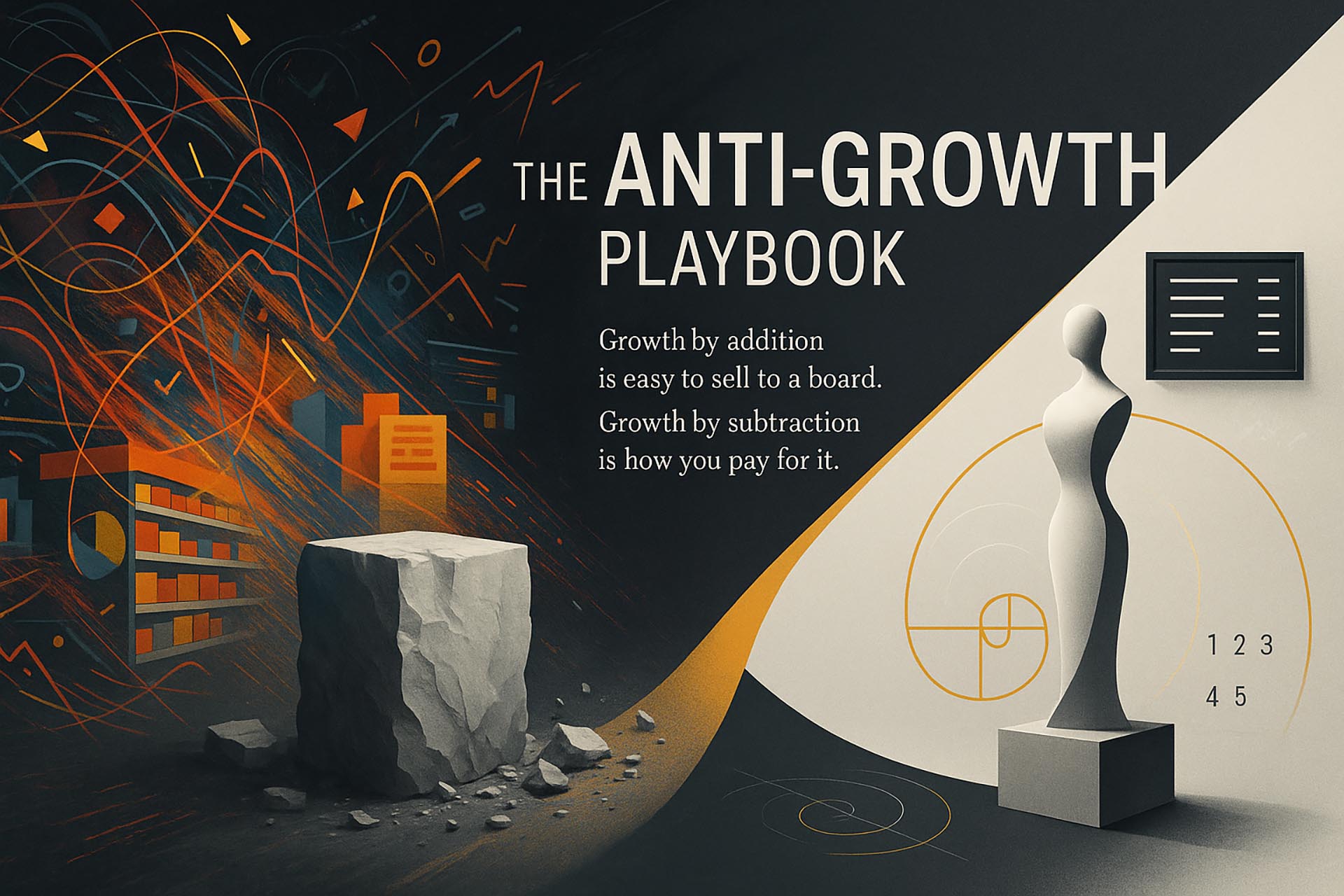
“Growth by addition is easy to sell to a board.
Growth by subtraction is how you pay for it.”
Take Costco an example, they typically run ~4000 SKUs versus ~30,000 at typical supermarkets and the results speak for themselves. Intentional scarcity, increase in inventory velocity, and massive purchasing leverage to keep costs LOW.
Apple is another great lesson from the history books. When Steve Jobs returned in 1997, Apple’s product line was a gordian knot. In typical Job’s fashion, he kept it simple – drew a 2×2 grid – Consumer/Pro X Desktop/Portable – then killed everything that didn’t fit.
As a result, Newton didn’t make the cut and Apple returned to profitability in 1998, posting net income in all four quarters with operating expenses down $560M year over year.
Simple is better.
Just look at In-N-Out Burger restaurant…what do you notice when you order?
…only 4 things on the menu.
Chipotle – same simple concept.
If you want to avoid the complexity margin tax, here are the SIMPLE takeaways:
- Don’t prioritize, de-prioritize down to first principles.
- If “selection” becomes your moat, you’re in the wrong castle.
- Curation beats an assortment of choices every time.
- Standardization is a hidden growth strategy, go find yours.
The Algorithm for Subtractive Growth
For further clues on how to maximize your growth through subtraction – spend some time studying first principles thinking. It’s all you need to know.
Based on my own version of first principles reasoning, here’s my simple 5-step framework for subtractive growth.
Warren Dow’s 5-Step Framework for Subtractive Growth
1. Question Every Requirement (& Everything Else in the Process)
– Revisit “The 5 Whys” and put it into practice. Thinking in terms of first principles, make sure you understand where every “requirement” comes from. Looking for the “flashing red lights” – the “but we’ve always done it this way.”
2. Deconstruct the Business Operating System (OS)
– Delete, remove, eliminate any part, feature, process, step, etc. that you can – if things still work, it’s proof positive that you’re optimizing efficiency. Remember, you can always add things back in, but you want to get “down to the bones” of the OS to see the cracks.
3. Everything Must Pass the “Who Cares Test.”
– My favorite question in business and life…does it pass the “who cares” test? It’s a powerful mechanism to sniff out BS. Blend this test with “The 5 Whys” and you’ll find “the roots of all your trees” very quickly. Warning: You might drive yourself a bit crazy in the process, so apply patience and a little humility here, will ya?
4. Simplify and Then Optimize
– Only start optimizing after deletion and simplification. Never try to improve something that shouldn’t exist in the first place. Peter Drucker said it perfectly:
“There is nothing so useless as doing efficiently that which should not be done at all.”
The longer you let that thought marinate, the tastier your business will be, guaranteed!
5. Automation Comes Last
– Only automate after the above steps are done. Because automating an inefficient, broken or bloated process just makes everything slow down and creates bottlenecks. When I was running a $257M Commercial Printing company, the plant managers would love to pitch me $1M new “Efficiency Cap-Ex projects” all the time. I would always start by looking at the UTILIZATION rates of previous cap-ex projects and typically find less than 50% adoption…it’s the endless “hamster wheel” of wasted resources and inefficiency.
So, there you have it…
…my anti-growth playbook for sustained growth.
It’s a paradox – just how I like it.
MORE is about EGO.
LESS is about CHARACTER & PRINCIPLE.
The companies that I admire most didn’t scale because they added more (or started with more) – they scaled because they avoided the complexity marginal tax and used “compounding subtraction” as their force multiplier…
…and they did it without an ego.
Here’s to your new anti-growth playbook.
