


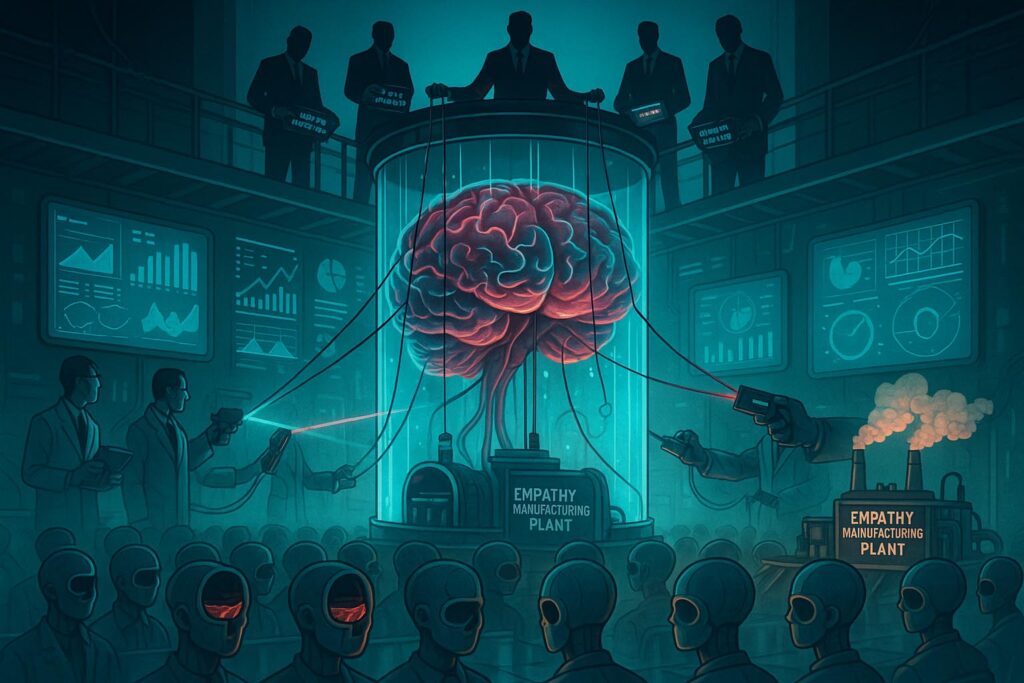
Artificial Empathy, Real Consequences: The Decline of Authentic Marketing
Humans are complicated creatures.
We’ve spent millennia trying to figure out what makes us tick, and yet we still barely understand what’s truly going on inside our heads.
One interesting study by psychologist Robert Francis Winch in 1955 revealed something profound about human nature: we’re magnetically drawn to others who possess the traits we lack. His “complementary needs theory” explained why opposites attract in relationships, and why movie stars want to be rock stars.
But digging deeper into Winch’s theory sixty-nine years later may explain something even more surprising when applied to the marketing industry – the rise of “artificial empathy.”
Just look around and you’ll see today’s marketing juggernaut desperately chasing “empathy-driven strategies” and “emotional connection” – and this has evolved into endless “virtue signaling.”
I’m afraid we’ve entered a new marketing era: an era that is clinically detached from human emotion – infecting the marketing world with a “mind virus.”
I’m calling it the Empathy Deficit Disorder.
And the numbers prove it: According to research by PwC, 64% of U.S. consumers and 59% of global consumers feel companies have lost touch with the human element and real customer experience. Meanwhile, trust in brands continues its relentless decline as customer satisfaction has been declining steadily since 2019.
If Albert Einstein were around today, he might chuckle at the absurdity: the more we scientifically study and chase empathy, the less empathetic we become.
The Neuroscience Paradox: When The Mirror Lies
Listen to any marketing buzzard or self-proclaimed thought-leader “go-roo” today and you’ll hear buzzwords like “neuromarketing,” “emotional AI,” and “empathy mapping.” Researchers are even developing “artificial empathy” frameworks for AI marketing agents – while brands invest millions in brain-scanning technology to decode consumer emotions and behavior.
And the quest to decode the decision-making process has companies using fMRI machines to map brain function and eye-tracking software to predict consumer behavior by analyzing visual attention and engagement with marketing and advertising.
Supposedly, the data provides insights into purchasing decisions. Hmm.
And it goes further – back in the early 1990s, a team of Italian neuroscientists led by Giacomo Rizzolatti discovered “mirror neurons,” – a special type of brain cells that fire when we observe others’ action.
Studies show that mirror neurons “facilitate empathy, allowing us to ‘feel’ the emotions of others and respond accordingly.” They’re the neurological basis for why we cry at movies and why seeing someone smile makes us smile back. It’s organic, automatic, and completely natural – just like “nature intended” .
But then the marketing buzzards swooped in… trying to engineer campaigns to “trigger mirror neurons, enhance engagement, and encourage positive brand associations.”
Soon enough, the major brands jumped right in – looking to capitalize on the wonderful world of mirror neurons so they can create artificial empathy.
A good example is Coca-Cola’s “Share a Coke” campaign – just look at all these smiley faces!
While they don’t explicitly state that they used “mirror neuron research” in their advertising campaigns – Coca-Cola is a prime example of big brands using neuromarketing techniques to “further engage consumers on a subconscious level.”
But think about the irony here…
…we’re literally putting people in machines to figure out how to better influence them…
…to connect with them on a deeper emotional level.
But let me be clear – the act of studying empathy in a laboratory in fundamentally anti-empathetic…
…it’s manufactured…
…and you can’t manufacture authentic empathy and human connection by analyzing brain waves any more than you can create “love by studying chemistry.”
It should be obvious, but the moment you try and engineer authenticity, it ceases to be authentic.
The oblivious marketing buzzards should know that genuine social connections are not made-to-order in manipulated focus-group tests on emotional triggers.
To paraphrase Pink Floyd in their epic song “Another Brick in the Wall,” …
…” Hey neuroscience freaks, leave us humans alone!”
Welcome to The “Manipulation Industrial Complex” (M.I.C.)
The research is clear: emotionally connected consumers are more than twice as valuable as highly satisfied consumers on a lifetime value basis. That’s why 85% of Gen Z customers trust a brand more when they learn a brand supports a social cause, 84% are likely to purchase, and 82% would recommend it.
Face value, perhaps this is good news, but instead it’s spawned the mighty M.I.C – an ecosystem of “empathy consultants” and “virtue signalists” – waging psychological warfare using ARTIFICIAL INTELLIGENCE on us dimwitted humans – treating us like data points in a digital sales factory.
Marketing has become toxic – a manipulation machine that manipulates, mimics, and misinforms human emotion at its core.
They’ve largely ignored the advertising legends of the past.
As David Ogilvy perfectly stated in 1955…
“The customer is not a moron. She’s your wife.”
Sadly, today’s marketing world does indeed think you and I are morons.
Failing to understand that all of this “manufactured empathy” and “customer-centricity” – has created a marketplace where consumers don’t trust anything anymore – the bull$hit detectors are forever on high alert!
The neuroscience is only telling us what our grandparents already knew: people can smell bull$shit from a mile away.
So, stop already.
The Data-driven Delusion: Welcome to the Marketing World’s New Illusion
According to Harvard Professor Gerald Zaltman, “our rational minds are not behind the wheel driving us to a purchasing decision; our subconscious is.”
This insight helps explain why the neuroscience marketing M.I.C. complex has exploded – all tripping over themselves to solve the mystery and decode our subconscious minds.
As repeatedly stated above – true human empathy can’t be mapped.
It’s not a destination you arrive at through data analysis – it’s a spiritual journey that you take with another human being.
It’s why A.I. can’t get true human empathy right either.
It can mimic and predict “what a human would want to hear,” but as the name explicitly states – it’s ARTIFICIAL.
Real empathy requires vulnerability, uncertainty, and the willingness to be wrong.
But these emotions don’t scale – so the M.I.C tries to engineer a workaround.
I’m afraid the marketing world has inadvertently created an “empathy crisis,” and we’re all suffering the consequences.
The real paradox: the companies that talk most about empathy today are often the least empathetic. And if you look closely and really start paying attention – these brands are easy to spot.
Are you one of them?
Is your business investing in manufacturing artificial empathy to manipulate purchasing decisions?
Are you marketing folks, so hell bent on conversions that you’ll stop using true human empathy in order to reach your sales goals?
Maybe it’s time we all look in the mirror.
The Way Forward: Radical Transparency, Authenticity, and Humility.
So how do we cure Empathy Deficit Disorder?
The answer is both simple and complex.
(You didn’t think I was going to let you off the hook that easy, did ya?)
Start with this – stop trying to engineer empathy artificially.
Go back to being a real human being.
If you forget – study children, despite their lack of intellect and life experience, they practice pure empathy – because it’s how we’re hard-wired.
But if you succumb to the new mass artificial desire to control and manipulate – you’re wiring will be frayed, and your human spirit will be broken.
Don’t do that – you’re better than that!
If you want a real competitive advantage in the market today – embrace authentic empathy in everything you say and do.
It’s the new radical contrarian strategy of treating customers like real human beings rather than a “wad of hundred-dollar bills.”
Because the best marketing strategy out there is and will always be, to give a damn about your customers and treat them as you would want to be treated – as real human beings.
Sources:
This article is based on peer-reviewed research, industry studies, and data from PwC, American Customer Satisfaction Index, Harvard Business Review, Nielsen, and multiple neuroscience journals. No marketing consultants were defamed or harmed in the making of this argument.